
Introduction
The notion of “Conclave” remains an ancient and rich tradition of the Church. The term often come into limelight whenever the pope dies, or when one discusses how the pope is being elected. Interestingly, there is no better word to describe the convocation of the cardinals for the purpose of electing the new Supreme Pontiff other than this term “the Conclave.” It is a period rooted in centuries of tradition; it represents not only the governance of the Church but also its faith in divine guidance.
Once again, the term has come up on many lips virtually in everyday discussion among Catholics and her separated brethren following the death of the Supreme Pontiff Pope Francis I on Easter Monday, April 21, 2025 at 88 who served for 12 years 1 month and 8 days; whose papacy is the ninth longest in the past 200 years. It is against this background, that we will take a look at some of the major events in the life of the Church after the Holy Father’s demise, declaration of Sede Vacante, Papal or Spiritual Testament, Rites of funeral, Sacred Conclave – that is the scene before the great proclamation: “Habemus Papam.”
Death and Declaration of Sede Vacante, the Pope Funeral and the Mourning Period
The death of a Pope marks the beginning of a series of events that lead to the eventual start of a conclave and election of a new Successor of St. Peter. Upon the demise of the Holy Father, the Camerlengo (Chamberlain of the Holy Roman Catholic Church) officially verifies the pope’s death. Traditionally, he calls the pope by his baptismal name three times. If there is no response, he declares him dead. As soon after the declaration, the Fisherman’s ring (a symbol of papal authority) is defaced and destroyed to prevent its misused. This will follow by an announcement by the Camerlengo, who will notify key Church officials, then the world. Vatican bells may toll in mourning. The pope's body typically lies in state for several days (usually 3-5 days) in St. Peter's Basilica, allowing the faithful to pay their respects, and then follows the interment officiated by the Dean of the College of Cardinals according to the Spiritual or Papal Testament of the deceased Pontiff. As in the case Pope Francis, his Spiritual Testament reads:
Pope Francis' Testament
Pope Francis' testament, dated 29 June 2022, has been published, giving indications for his burial in the Basilica of Saint Mary Major.
Miserando atque Eligendo
In the name of the Most Holy Trinity. Amen.
As I sense the approaching twilight of my earthly life, and with firm hope in eternal life, I wish to set out my final wishes solely regarding the place of my burial.
Throughout my life, and during my ministry as a priest and bishop, I have always entrusted myself to the Mother of Our Lord, the Blessed Virgin Mary. For this reason, I ask that my mortal remains rest - awaiting the day of the Resurrection - in the Papal Basilica of Saint Mary Major.
I wish my final earthly journey to end precisely in this ancient Marian sanctuary, where I would always stop to pray at the beginning and end of every Apostolic Journey, confidently entrusting my intentions to the Immaculate Mother, and giving thanks for her gentle and maternal care.
I ask that my tomb be prepared in the burial niche in the side aisle between the Pauline Chapel (Chapel of the Salus Populi Romani) and the Sforza Chapel of the Basilica, as shown in the attached plan.
The tomb should be in the ground; simple, without particular ornamentation, bearing only the inscription: Franciscus.
The cost of preparing the burial will be covered by a sum provided by a benefactor, which I have arranged to be transferred to the Papal Basilica of Saint Mary Major. I have given the necessary instructions regarding this to Cardinal Rolandas Makrickas, Extraordinary Commissioner of the Liberian Basilica.
May the Lord grant a fitting reward to all those who have loved me and who continue to pray for me. The suffering that has marked the final part of my life, I offer to the Lord, for peace in the world and for fraternity among peoples.
Santa Marta, 29 June 2022
(https://www.vaticannews.va/en/pope/news/2025-04/pope-francis-spiritual-will-and-testament.html)
However, the above testament started with his motto “Miserando atque eligendo” a phrase which can be translated as: “By having mercy and by choosing him” or in a more simpler way: “Lowly but chosen.” The motto is an extraction from a homily by Saint Bede the Venerable who describes Jesus’ call to Matthew, the tax collector, in the Gospel pericope according to Evangelist Matthew (cf. Matthew 9:9).
Just after the Pope’s demise, all Heads of Dicasteries of the Roman Curia resign with some exceptions which aimed at maintaining the regular operations of the Vatican. Those who maintain their duties include: the Cardinal Camerlengo, who has the task of overseeing and administering the temporal goods and rights of the Apostolic See during the time of its vacancy; the Major Penitentiary, the Cardinal Vicar General for the Diocese of Rome; the Cardinal Archpriest of the Vatican Basilica and Vicar General for Vatican City; the Almoner of His Holiness; the Substitute for General Affairs of the Secretariat of State; the Secretary for Relations with States and, the Master of Pontifical Liturgical Celebrations. Also, the Secretaries of the Dicasteries remain in place.
In the light of this, during the Sede Vacante period, the College of Cardinals (who all convened in Rome, except in cases of health-related impediments) meets in two types of Cardinal Congregations:
- a. General Congregations: These include the entire College of Cardinals (including those over the age limit for electing the new Pope). These General Congregations are held in the Apostolic Palace and are presided over by the Dean of the College. If the Dean and the Sub-Dean are unable to preside, the senior Cardinal elector takes over.
- b. Particular Congregations: These are composed of:
- The Cardinal Camerlengo of the Holy Roman Church and three Cardinals, one from each Order (Bishops, Priests, and Deacons), chosen by lot from among the Cardinal electors;
- These three assisting Cardinals serve for three days, after which they are replaced through a new random selection. This process continues even during the election;
- The Particular Congregation handles daily ordinary affairs, while more serious matters must be referred to the General Congregation.
The General Congregations (held before the start of the election process) must promptly deliberate on the following key decisions (excluding procedures related to the Pope's death):
- Prepare accommodations at the Domus Sanctae Marthae for the Cardinals and set up the Sistine Chapel for the election procedures;
- Assign two distinguished and morally authoritative ecclesiastics the task of delivering two reflections to the Cardinals on the current challenges of the Church and the enlightened choice of the new Pope, and set the date for these reflections;
- Destroy the Fisherman’s Ring and the Lead Seal, which were used to authenticate Apostolic Letters.
The Sacred Conclave
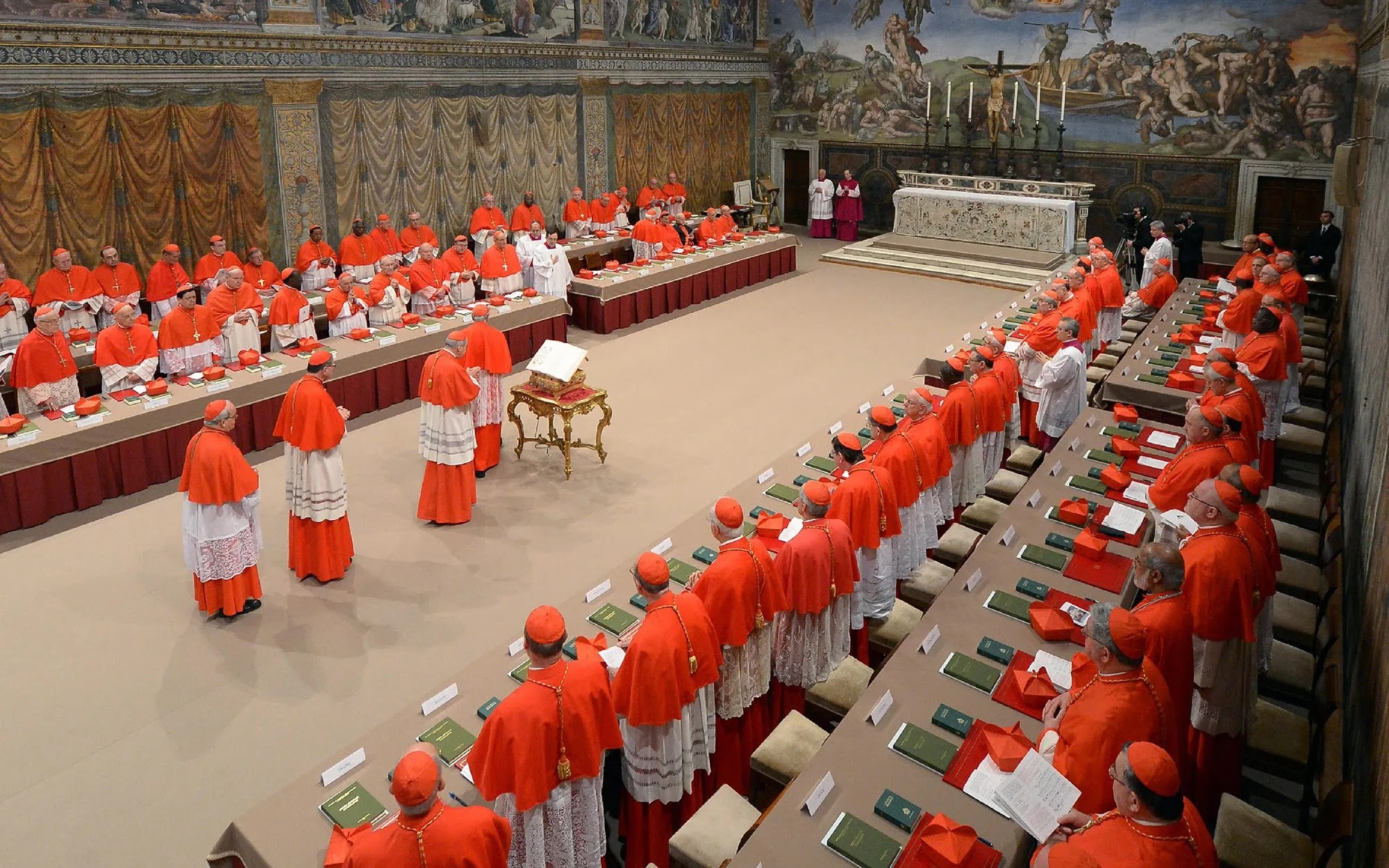
The Sacred Conclave stands as one of the most solemn and mysterious traditions of the Roman Catholic Church. This ancient and revered ceremony is the process through which the Church elects a new pope, the spiritual leader of over a billion Catholics worldwide.
The concept “conclave” is derives from the Latin usage cum clave, meaning "with a key," signifying the tradition of locking the cardinal electors away until a new pope is chosen. This ensures the secrecy and solemnity of the proceedings, shielding the election from external influences. The practice was formalized in 1274 by Pope Gregory X, following a lengthy papal vacancy that had lasted almost three years. Since then, conclaves have been governed by strict rules designed to maintain their spiritual focus and integrity.
The conclave is held in Vatican City, with the voting sessions taking place in the historic Sistine Chapel beneath Michelangelo’s iconic frescoes. Cardinals under the age of 80 are eligible to vote and are sequestered for the duration of the conclave. Each day, they participate in up to four ballots, requiring a two-thirds majority to elect a new pope. After each vote, the ballots are burned - producing black smoke if no decision has been reached or white smoke to signal the successful election of a pope. The atmosphere within the conclave is deeply spiritual. Before voting, they celebrate a special Mass called Pro Eligendo Papa, at this Mass the cardinals pray for the guidance of the Holy Spirit. The goal is not political ambition but the discernment of God's will for the Church. In this sacred context, the conclave transcends a mere election - it becomes a moment of divine encounter and responsibility.
Over the centuries, the conclave has evolved, adapting to changing times while preserving its essential character. Modern popes, such as John Paul II and Benedict XVI, introduced procedural reforms, including the use of the Domus Sanctae Marthae as a residence for electors. In a decree promulgated by Pope St. John Paul II on February 22, 1996, the Solemnity of the Chair of Peter, the Apostolic Constitution Universi Dominici Gregis revised and updated the norms in force until then regarding the apostolic succession in the See of Peter, which had been regulated by Pope Paul VI’s Apostolic Constitution Romano Pontifici Eligendo (1975). This document is divided into two parts:- -- The first governs the Vacancy of the Apostolic See or Sede Vacante, meaning the period between the cessation of the Pope’s governance of the Church and the election of his successor.
- The second outlines the procedures for the preparation and conduct of the election of the Roman Pontiff.
On another note, technology is strictly banned, emphasizing the timeless nature of the event in an increasingly connected world.
In conclusion, the Sacred Conclave is much more than a tradition - it is a profound expression of faith and unity. It reflects the Church’s enduring commitment to spiritual leadership through prayerful discernment. As white smoke rises from the Sistine Chapel, the world witnesses not just the election of a new pope, but the continuity of a sacred mission. When a two-thirds majority has been attained, the newly elected Pope will accept the office, and then chooses a Papal Name. This exercise will be followed by an announcement to the whole world from the balcony of St. Peter by the Cardinal Protodeacon: “Habemus Papam!” followed by the new pope’s name. The newly elected pope then gives his first apostolic blessing: (Urbi et Orbi – to the city and the world).
Conclusion
As the conclave draws near, the world stands at the threshold of a moment both sacred and decisive. The gathering of cardinals, steeped in centuries of tradition, represents not just the continuity of the Church but also its capacity for renewal. Ahead of Conclave: Moment of Divine Decision has traced the weight of expectation, the complexities of human discernment, and the ever-present hope for divine guidance. In this moment, history and spirituality converge, a solemn reminder that, while the cardinals cast their votes, it is ultimately believed to be the Holy Spirit who chooses. The conclave is not merely an election; it is a profound act of faith. As the smoke rises from the Sistine Chapel, the world will look on, awaiting not just a name, but a vision for the future.
Finally, from silence, a Shepherd shall rise, history will turn, with smoke a new hope will appear as guided by the Spirit. Let us therefore pray as we await in patience the Fisherman’s heir.

No comments:
Post a Comment