Friday, February 19, 2021

DIVINE WHISPER with FR. PIUSRALPH EFFIONG, SMMM


              DIVINE WHISPER 

                       with 
            
    Fr. PiusRalph Effiong, SMMM

 SATURDAY AFTER ASH WEDNESDAY


And the Lord will guide you...

Thus says the LORD: "If you take away from the midst of you the yoke, the pointing of the finger, and speaking wickedness, if you pour yourself out for the hungry and satisfy the desire of the afflicted, then shall your light rise in the darkness and your gloom be as the noonday. And the LORD will guide you continually, and satisfy your desire with good things, and make your bones strong; and you shall be like a watered garden, like a spring of water, whose waters do not fail. (Is.58: 9ff.)

Today's prophecy by Isaiah goes with a caveat, which must be fulfilled. A call to upright life, sincerity and a true witness of the gospel not minding whose "ox" gored or "feather" hemmed. As the Catholic Bishops Conference of Nigeria in her letter which had "Prayer and penance for peace and security in our country"  as the theme and read during last year's Service of Ash Wednesday in all Nigerian Churches obliged us to be true Christians even in our most difficult moment. This will therefore give us true identity of members of the Christ's body - the Church. The show of faith must not always be in comfort zone, we must detach from something to attach with God. We must also deny ourselves some kind of comfort and pleasure for others, if truly we want our desires to be satisfied by God.  Peace be with you!
Fada PiusRalph prays for you.

Let us pray
God of Mercy and compassion, teach us Your way so that we may walk in your path. May our daily Lenten observance (s) be carried out in sincerity of heart, through Christ our Lord. Amen.

Tuesday, February 16, 2021

REMEMBER THAT YOU ARE DUST...The Spiritual Significance of Ash Wednesday’s Liturgical Celebration

REMEMBER THAT YOU ARE DUST...
The Spiritual Significance of Ash Wednesday’s Liturgical Celebration
                                                                         
INTRODUCTION
Pope St. Clement I in his letter to the Church in Corinth avers, “For we have only to survey the generations of the past to see that in every one of them the Lord has offered the chance of repentance to any who were willing to turn to him. When Noah preached repentance, those who gave heed to him were saved. When, after Jonah had proclaimed destruction to the people of Nineveh, they repented of their sins and made atonement to God with prayers and supplications, they obtained salvation, notwithstanding that they were strangers and aliens to him.” (The Second Office of Reading for Ash Wednesday, The Divine Office, Vol. II (Lent and Easter), p. 6). 
Taking a lift from St. Clement’s epistle to the Corinthians one will not in any way deny God’s ever readiness to welcome us back to Himself no matter how scarlet our sins may be. The only thing He asks of us, is the willingness to return to Him. 

Recalling the prophecy of Ezekiel, “If a wicked man turns away from all the sins he has committed and keeps all God’s decrees and does what is just and right, he will surely live; he will not die. None of his offences will be remembered against him. Because of the righteous things he has done he will live.” (Ezekiel 18:21-22). This same proclamation was made by Christ inviting you and I to repent of our sins for the kingdom of God is at hand. (cf. Matt 4:17).

 It is against this background that the Church invites us into the solemn season of Lent with the service of Ash Wednesday, as a preparatio for the forty days long walk of prayer, fasting and almsgiving with the Lord. The term “Ash” is referred to as earthly or mineral combustible substances remaining after combustion, as woods or coal. It may also be designated with the term “dust”. Within the context of this work, we will use both terms interchangeably. In the light of this unique event in the economy salvation of man, we will take a look at the biblical imports, historical dimension of the Ash Wednesday liturgy, the rite of imposition of ashes, as well as its spiritual significance in our lives.

BIBLICAL BACKGROUND
There are various instances both in the Hebrew and Christian Testaments where God invites man to reconciliation. 
In the Old Testament account, Prophet Joel invites the people of Israel to return to the Lord with all their hearts, with fasting, weeping and mourning. (cf. Joel 2:12-13). Malachi also prophesy to the Israelites God’s willingness to return to them if they are willing and ready to return to Him. (cf. Mal 3:7). Ezekiel further revealed that God does not take pleasure in the death of the wicked (cf. Ezek 18:23). In the same way that Isaiah reminded the people of Israelites of God’s invitation to sinners to depart from their old ways. (cf. Isaiah 55:7). Now the question is. How do they approach the “throne of mercy” for the forgiveness of their sins? The Holy Scripture has cited various instances and approaches of seeking God’s face for repentance by the people of the old. The scripture narrates various forms of the penitential acts. Among them are: putting on sackcloth, weeping, mourning, sitting on ashes, rubbing of ashes, fasting, etc. But our concern is the act involving fasting and ashes which are part of the Ash Wednesday’s liturgical rite.
 In the Old Testament ashes and dust were used as signs of mortality and worthlessness, sorrow and repentance. Now let us take a closer look into instances where ashes were used as penitential gesture. When Tamar was raped by her half-brother, "she sprinkled ashes on her head, tore her robe, and with her face buried in her hands went away crying" (2Samuel 13:19). The sign was used to express sorrow for sins and faults. In Job 42: 6, Job says to God: “Therefore I retract, and I repent in dust and ashes”." The prophet Jeremiah calls for repentance by saying: "O daughter of my people, gird on sackcloth, roll in the ashes" (Jer 6:26). The prophet Daniel recounted pleading to God: "I turned to the Lord God, pleading in earnest prayer, with fasting, sackcloth and ashes" (Daniel 9:3). Just prior to the New Testament period, the rebels fighting for Jewish independence, the Maccabees, prepared for battle using ashes: "That day they fasted and wore sackcloth; they sprinkled ashes on their heads and tore their clothes" (1 Maccabees 3:47; see also 4:39). 

On the other hand, the New Testament account gives different episodes where  Christ employed through the parables to invite us to reconciliation. Among them are: Parables of the lost sheep, coin and prodigal son to remind us of God’s unfathomable mercy depending on our willingness and acceptance to return to Him. (cf. Matt 18:12-14; Lk 15:8-10; Lk 15:11-32).
Here Christ made allusion to this saying: “Woe to you, Chorazin! Woe to you, Bethsaida! For if the miracles had occurred in Tyre and Sidon which occurred in you, they would have repented long ago in sackcloth and ashes.” (Matt 11:21).

 However, in view of these scriptural passages we have seen the basic events where ashes were used. It is symbolically representing “metonoia” that is repentance or changing ones’ way of life being the focal point for this reflection. At this juncture, let us take a step into the historical background of Ash Wednesday liturgy and how ashes came into the celebration.

THE HISTORICAL BACKGROUND OF ASH WEDNESDAY LITURGY
Historically, the ashes of burned objects such as plants, animals, human bodies and dust are commonly found in use among ancient peoples for religious, magical and medical purposes. Among these ashes there are certain ashes or dust that have sacred character and power, above all, ashes or dust signify mortality, mourning and penance or repentance. In line with this ritual, Christian liturgical usage and symbolism of ashes or dust is traced to Jewish tradition.

Presently, the Roman liturgy uses ashes only on Ash Wednesday liturgy. The practice of all the faithful receiving ashes on their heads has been a universal since the synod of Benevento in 1091. However, this was known by the Anglo-Saxons a century earlier. The first prayer for the blessing of the ashes gives them a sacred character as sacramental for healing from sin; the other three prayers and the formula of imposition express their symbolism of mortality. Originally ashes were used as signs of private penance; then they became a part of the official ritual for public penitents and were given to them only. (cf. Johnson, E. J., Ashes, Liturgical Use Of, New Catholic Encyclopaedia, Vol. I USA: Jack Heraty & Associates, Inc., 1967,  p.948).
Christians continued the practice of using ashes as an external sign of repentance. Tertullian (c. 160 – c. 225) said that confession of sin should be accompanied by lying in sackcloth and ashes. The great Church historian Eusebius (c. 260/265 – 339/340) recounts how a repentant apostate Pope Zephyrinus covered himself with ashes when begging to re- admit him to communion. John W. Fenton writes that "by the end of the 10th century, it was customary in Western Europe (but not yet in Rome) for all the faithful to receive ashes on the first day of the Lenten fast. In 1091, this custom was then ordered by Pope Urban II at the council of Benevento to be extended to the church in Rome. Not long after that, the name of the day was referred to in the liturgical books as "Feria Quarta Cinerum" (i.e. Ash Wednesday)." (cf. Fenton, J. W., "Orthodox Ash Wednesday",  Antiochian Western Rite Vicariate., 2013). The public penance that grave sinners underwent before being admitted to Holy Communion just before Easter lasted throughout Lent, on the first day of which they were sprinkled with ashes and dressed in sackcloth. 
At the dusk of the first millennium, the discipline of public penance was dropped, the season of Lent began, seen as a general penitential period, was marked by sprinkling ashes on the heads of all during Ash Wednesday liturgy till date. This practice is found in the Gregorian Sacramentary of the late 8th century. ("Ash Wednesday". Encyclopedia Britannica).

ASH WEDNESDAY’S LITURGICAL RITE AND ITS SPIRITUAL SIGNIFICANCE 
Ash Wednesday marks the start of a 40 -day period which is an allusion to the separation of Jesus in the desert to fast and pray. During this time he was tempted. Matthew 4:1–11, Mark 1:12–13, and Luke 4:1–13. While not specifically instituted in the Bible text, the 40-day period of repentance is also analogous to the 40 days during which Moses repented and fasted in response to the making of the Golden calf. (cf. Exodus 34:27-28). In the Jewish religious setting till date, the Jews follow a 40-day period of repentance in preparation for and during the High Holy Days from Rosh Chodesh Elul to Yom Kippur (the day for atonement). 
Ash Wednesday is observed by fasting, abstinence from meat and repentance. In the Western Christianity it is first day of Lent. It occurs 46 days (40 fasting days, if the six Sundays, which are not days of fast, are excluded) before Easter and can fall as early as February 4 or as late as March 10. Ash Wednesday is observed by many Western Christians.  The days derives its name from the practice of blessing ashes made from Palm branches blessed on the previous year's Palm Sunday, and placing them on the foreheads of participants with the accompaniment of the words "Remember that you are dust, and to dust you shall return", an Extract from the Old Testament. (Genesis 3:19). 
In the 1969 revision of the Roman Rite, an alternative formula based on Mark 1:15, “Repent, and believe in the Gospel” was introduced and given first place. The old formula, based on the words spoken to Adam and Eve after their sin, reminds worshippers of their sinfulness and mortality and thus, implicitly, of their need to repent in time. (cf. Bucher, R. P., "The History and Meaning of Ash Wednesday" as culled from "Ash Wednesday". Encyclopaedia Britannica). The newer formula makes explicit what was only implicit in the old.
However, the act of imposition of ashes varies; various manners of placing the ashes on worshippers' heads are in use within the Roman Rite of the Catholic Church, the two most common being to use the ashes to make a cross on the forehead and sprinkling the ashes over the crown of the head. Originally, the ashes were strewn over men's heads, but, probably because women had their heads covered in church, were placed on the foreheads of women. In the Catholic Church the manner of imposing ashes depends largely on local custom, since no fixed rule has been laid down.
Consequently, the significance of this religious act cannot be over emphasized, as we are always and at every point in time in need of God’s mercy and compassion. It is a moment of return to the Lord with prayer fasting and repentance. The service of Ash Wednesday puts us in the right liturgical atmosphere to begin the forty days of long walk with the Lord. Ashes remain a sacramental. Their reception with humility is a sign of penance. We wear them publicly to acknowledge our need to atone for our sins. "God desires not the death of the sinner." He is moved by our humiliation, and His justice is appeased by satisfaction, Says Eileen O'Callaghan. It symbolizes the transience of our earthly status. The body must fall temporarily into dust. This fact should serve as a challenge to spiritual accomplishments. Through grace we were "buried" in Christ that we may rise with him and "live unto God." 

CONCLUSION
Recalling the words of Thomas Merton, “Even the darkest moments of the liturgy are filled with joy. And Ash Wednesday, the beginning of the Lenten fast, is a day of happiness, a Christian feast. It cannot be otherwise, as it forms part of the great Easter cycle.” In this spirit, the service of Ash Wednesday should ignite in us a spark of joy for yet another great moment the Church has offered us to reconcile with the Father. It goes beyond the outward wearing of the ashes on our foreheads in the public. The primary spot of this celebration is our heart. As Fr. Saunders the President of the Notre Dame Institute for Catechetics will say “We again convert our hearts to the Lord, who suffered, died, and rose for our salvation. We renew the promises made at our baptism, when we died to an old life and rose to a new life with Christ finally, mindful that the kingdom of this world passes away, we strive to live the kingdom of God now and look forward to its fulfilment in heaven.”
Finally, my dear brothers and sisters in the Lord; let us join the Mother Church in the celebration of this liturgy for the sanctification of our souls by making sincere effort in putting ourselves within the ambience of this solemn season. To crown it all, reflect with me on the words of St. John Baptiste Marie Vianney who avers “At the time that we deprive ourselves of anything which gives pleasure to do, we are practising a fast which is pleasing to God because fasting does not consist solely of privations in the way of eating and drinking, but of denying ourselves what pleases us most”. Peace! Be with you.
        FR. PIUSRALPH EFFIONG, SMMM
                Piusralphe@gmail.com
                    +2348 0668 90324

Monday, July 13, 2020

THE PLACE OF BLESSED VIRGIN MARY IN THE ECONOMY SALVATION OF MAN: - FR. PIUSRALPH EFFIONG,SMMM piusralphe@gmail.com

THE PLACE OF BLESSED VIRGIN MARY IN THE ECONOMY SALVATION OF MAN


PROLEGOMENA: The doctrine of Mary as the co-redemptrix, Mediatrix and advocate in the economy of   man’s salvation right from time immemorial has been a protracted enigma that has raised dust among our separated brethren; who neither wish to ask questions nor bend down to read about the mystified co-participation of this second Eve in the salvation history of man. Following the Catechism of the Catholic Church, Mary’s role in the salvation history of man is tripartite in nature. Thus: a Co-redemptrix, a Mediatrix, and an Advocate (cf. Catechism, no. 969). These multilateral roles played by our lady, is part of the constant teachings of the Church. Saint Paul teaches us that “there is one mediator between God and men, the man Christ Jesus, who gave himself as a ransom for all” (1 Tim. 2:5).  However, Mary’s participation in the salvation history of man as Mother of Christ and Mother of Christians does not diminish the unique mediation of Christ; rather it points to Christ’s unique mediation and reveals its power (Lumen Gentium 60). It is on this note that this insightive work built on the scripture, documents of the church fathers and lessons from the sacred magisterium have set out to take a circumspective look into this age long controversial issue.  For the sake of clarity and understanding it is pertinent to explicate the three major concepts involved in this work: co-redemptrix, Mediatrix and advocate.

CONCEPTUAL FRAMEWORK:
The concept of Mary as Co-redemptrix, Mediatrix, and Advocate for the People of God is an ancient dogma in the church's teaching. The early Church manifested her heartfelt belief in the intercessory power of Mary, to whom she called for help and protection in the midst of dangers and trials. The Salve Regina (Hail Holy Queen), composed in the eleventh century, includes this venerable title. Vatican II continues this ancient practice of invoking Mary under the title that conveys her role as intercessory helper for the People of God in times of peril: “Therefore the Blessed Virgin is invoked in the Church under these titles....” (Lumen Gentium 62).
 Consequently, we can boldly proclaim that the Co-redemptrix, Mediatrix and advocate roles of our lady, who uniquely participated with the one Redeemer in obtaining the graces of redemption, continues her participation by distributing the graces of redemption with the one Mediator, Jesus Christ, and the Sanctifier, the Holy Spirit. Part of this mediating role of Mary in God’s plan of salvation includes the providential task of being the Advocate for the People of God, that is, a mother pleading on behalf of her children. Thus, Mary not only mediates the graces of God to humanity as Mediatrix, but she also mediates the petitions of the human family back to God as our Advocate. The title “Co-redemptrix” is a term that refers to Mary’s unique and intimate co-operation with her divine Son in redeeming the human family. The title is rooted in Genesis 3:15, where Mary is “prophetically foreshadowed in the promise of victory over the serpent” (Lumen Gentium 55). This passage foreshadows the divine work of redemption brought about by Jesus as the Savior of the world, with the Mother of the Redeemer’s intimate cooperation. The prefix “co” in the title “Co-redemptrix” does not imply equality with the one Redeemer, Jesus Christ, who alone could reconcile humanity with the Father in His divinity and humanity. The prefix “co” is derived from the Latin word cum, which means “with,” and not “equal to.” Jesus as true God and true man redeems the human family, and Mary as “Co-redemptrix” participates with the divine Redeemer in a completely subordinate and dependent way. Nonetheless, though subordinate and dependent, Mary’s human participation remains a uniquely privileged and exalted one, one that was entirely contingent upon her free and meritorious “yes” in her words, “Let it be to me according to your word” (Lk. 1:38).

THE MYSTERIOUS ROLES: DYSMISTIFIED  
Blessed Pope John Paul II in his apostolic letter Tertio Millenio Adveniente (The Coming Third Millennium), he stated that Mary’s co-redemptive role in the salvation of man is in fact constantly points to her Divine Son and she is proposed to all believers as the model of faith which is put into practice. (N. 43) 
Perusing through the pages of both Old and New Testaments of the sacred scripture, as well as the ancient writings of our Patriarchs, there is a clear indication of Mary’s role in the economy salvation of man. The books of the Old Testament described the history of man's salvation, by which the coming of Christ into the world was slowly prepared. According to the earliest documents of our fathers in faith, we come to understand in the light of a further and full revelation, bringing the figure of the woman, Mother of the Redeemer, into a clearer light.  When it is looked at in this way, she is already prophetically foreshadowed in the promise of victory over the serpent which was given to our first parents after their fall into sin. (Document of Vatican Council N.284) Likewise she is the Virgin who shall conceive and bear a son, whose name will be called Emmanuel. (Document of Vatican Council N . 285)

 She stands out among the poor and humble of the Lord, who confidently hope for and receives salvation from Him. With her, the exalted Daughter of Zion, and after a long expectation of the promise, the times are fulfilled and the new economy established when the Son of God took a human nature from her that He might in the mysteries of His flesh free man from sin. The Father of mercies willed that the incarnation should be preceded by the acceptance of her who was predestined to be the mother of His Son, so that just as a woman contributed to death, so also a woman should contribute to life. That is true in outstanding fashion of the mother of Jesus and thus designating her with the tittle the “second Eve”, who gave to the world Him who is Life itself and who renews all things, and who was enriched by God with the gifts which befit such a role.
In view of this, the fathers of the church see her as used by God not merely in a passive way, but as freely co-operating or co-participating in the work of human salvation through faith and obedience. For, as St. Irenaeus says, she "being obedient, became the cause of salvation for herself and for the whole human race" Hence, not a few of the early Fathers gladly assert in their preaching, "The knot of Eve's disobedience was untied by Mary's obedience; what the virgin Eve bound through her unbelief, the Virgin Mary loosened by her faith"  Comparing Mary with Eve, they call her "the Mother of the living," and still more often they say: "death through Eve, life through Mary." This union of the Mother with the Son in the work of salvation is made manifest from the time of Christ's virginal conception up to His death it is shown first of all when Mary, arising in haste to go to visit Elizabeth, is greeted by her as blessed because of her belief in the promise of salvation and the precursor leaped with joy in the womb of his mother. 

EPILEGOMENA: Mary’s tripartite role in economy salvation of man is a constant reminder to the faithful that we must all work alongside the Redeemer in bringing the saving Gospel of Christ into the world; to offer our meritorious sufferings for the glory of God and the salvation of souls in the order of the priesthood of the laity, as well as in the ministerial priesthood; to participate through acts of charity and Christian works of mercy in the application of the graces of Calvary to the world today, a world that remains in such grave need of the Redeemer’s spiritual and social liberation; to realize the sublime ecclesial dignity of freely and personally co-operating and co-participating with grace for our own salvation and the salvation  of all humanity; and  to be incarnate witnesses after the model of Mary’s co-redemptrix nature to the fundamental truth that human suffering can be redemptive. Our role as “co-redeemers in Christ” provides a concrete reminder to today’s faithful that the Cross of the Redeemer must again be implanted in the midst of the world and carried by every beloved disciple for the salvation and sanctification of contemporary society.

Wednesday, July 8, 2020

Reflection for Wednesday, July 8, 2020

Wednesday 8th July, 2020.

14th week in Ordinary Time – Year II

1st Reading = Hosea 10:1-3.7-8.12                                                                                                                                           Resp. Psalm = Ps 105:2-7                                                                                                                                                        Gospel = Matthew 10:1-7

Jesus in today’s gospel calls twelve of His disciples by name to be His apostles. He sent them to be go to the lost sheep of the house of Israel. He gave them power and authority over demons and unclean spirits. This only goes to show the closeness Jesus had with them. The word ‘apostle’ is from the Greek word ‘apostolos’ which means ‘one who is sent.’ Put differently, an apostle is an official representative charged with a commission and a mission, and he empowered by the authorization of the sender rather than the content of the commission and mission.

We too, by our baptism and confirmation, are apostles in a broad sense because we are sent by Jesus to proclaim His good news of salvation and God’s Kingdom. We have been empowered by being confirmed in Christ, to be His soldiers everywhere we are. We as Christians, we should know how to communicate the message of Christ to the different people who are part of our daily living, especially those who have abandoned the right path; they are the lost sheep of the house of Israel. We may not be far better but we must not wait for us to become saints before we offer help.

Dear friends, how often do we pray for those whose lives we would love to see given to Christ? How do we treat such a person who is adamant to change, who may even have gone out of control? Do we abandon them to themselves and say ‘I hand you over to God’ or ‘May the Holy Spirit touch you’ ? But we forget that we are the instruments the Holy Spirit will use to transform such a one. Do we discuss our faith, the doctrine and teachings pf the Church or even the Gospel of the day with our friends? Do we much as make any reference to it in our discussions? If we don’t, how does the person get transformed or at least inspired? What ways do we use for evangelization on such people, if at all we do? Are we patient with them or do we expect transformation to be immediate? Do we carry out evangelization because we just want to get people into our Churches or because we really care about the person’ life? Remember, salvation is partly rooted in morals and worship in the true faith stemming from the ‘Apostles’.

Dear people of God let us not abandon the mission handed to us to the priests and religious around us, but let’s do our own part of the job, for we are all sent and apostles in our little ways. May St Killian (Apostle of Franconia), St Adrian III and the Martyrs of Shanxi, help us to be better apostles beginning from our families and then to the entire world. We make our prayer through Christ our Lord, Amen.

Have a great day.

Fr Kevin N. Lereh, M.Ss.Cc                                                                                                                                                    Together in Prayer

Tuesday, June 30, 2020

The AGNES' PALLIUM - FR. PIUSRALPH EFFIONG, SMMM


Eureka! The ARCHIVE is here again at your door step to bring to you yet another insight into the Church's history: The AGNES PALLIUM. This is one of the insignias of the office of the Metropolitan archbishops and Patriarchs.
The AGNES’ PALLIUM
June 29 every year marks the solemnity of two great Apostles – Peter and Paul. St. Peter was chosen by the Lord to be the leader of the Church and given the task to preach the Gospel especially among the Jewish communities; while Apostle Paul became the chosen instrument of God to bring the Good news to the whole world. In the process of conversion, both apostles experienced the gratuitous compassion and forgiveness of the Lord. Today, these great men are considered in the Christian history as ancestors in the faith. Besides the solemn celebration of these great men of faith in the Catholic Church globally, there is one particular event that takes place on this same day that has to be given a special mention.

It is on this fateful day that the Pope gives out Pallium (which is attributed to St. Agnes) to the Metropolitan Archbishops and Patriarchs appointed within the year. To some, this term ‘pallium’ sounds so strange in their ears, while others do not need an interpretation. But one thing is significant about “the Pallium,” that is the connection between the Pallium and St. Agnes. In a bit to explain the cordial relationship existing between this virtuous Virgin and Pallium, it is out of necessity to give an account of the life of St. Agnes. The little we know about St. Agnes is that she was only 13 years old when she dedicated her maidenhood to Christ, much to the outrage of her many suitors. When she refused to change her mind, Agnes was handed to the authorities. According to one story told about her, she was put in a brothel, but any man who made advances on her was blinded and paralyzed. They then tried to burn her at the stake, but the wood would not ignite. Finally, she was decapitated on the Via Nomentana outside of Rome. Agnes went to her execution, St. Ambrose tells us, “more cheerful than others go to their wedding” Later on in history, the Emperor Constantine erected a basilica over her tomb. The basilica is known today as St. Agnes Outside the Walls, where her mortal body is preserved, while her skull is in the side chapel in the Church of St. Agnes of Agony in Piazza Navonma in Rome.

Today, it is also noted that the Trappist monastery of Tre Fontane (Three fountains) on the outskirt of Rome has something in common with this virgin and martyr. The monastery has raised two lambs in her honour that are involved in a charming and ancient tradition, (recalling the fact that Agnes’ name is derived from agnus, the Latin word for Lamb, and it evokes the Greek word agnos, meaning pure). It is worthy to note that, on the day before her feast, the lambs are taken to the Sisters of the Holy Family of Nazareth, where they groomed and coddled. The next morning the lambs are decorated with roses and a mantle that reads S. A. V. (St. Agnes Virgin) and the other wears a red mantle that reads S. A. M. (St. Agnes Martyr). The sisters have had the privilege of tending these lambs since 1884AD, when they inherited it from neighbouring convent closed down.

Once the lambs are ready, they are picked up by members of the Order of Lateran Canons Regular, who serve Sant’ Agnese fuori le Mura, and taken to the basilica. A morning Mass is celebrated, and the abbot of the Order blesses the lambs on the altar. From there, they are taken to the Vatican, where the pope himself receives and blesses them. The lambs are later shorn on Tuesday of Holy week, and their wool used by the nuns of the Benedictine convent of St. Cecilia in Trastevere, Rome, to make Palliums. When they are ready, the Palliums are placed in a bronze urn next to the chair of St. Peter in St. Peter’s Basilica. There they stay until the Feast of Ss. Peter and Paul on June 29, when it will be given out to the newly appointed Metropolitan Archbishops.
 According to Dom Gueranger, this simple woolen ornament worn by the Supreme Pontiff and the Archbishops “carries to the very ends of the world the sublime union of… two sentiments – the vigour and power of the Prince of Apostles, and the gentleness of Agnes the Virgin.” (Quoted in Michael P. Foley’s Agnes’ Pallium, Messenger of St. Anthony, January 2012). It is now clear to an extent why and how this unique symbol of authority is called the ‘Agnes’ Pallium’.

However, the Pallium which Pope Emeritus, Benedict XVI wore and now put on by the present Supreme Pontiff, Francis I has five crosses which symbolizes the five wounds of Christ and is fastened with three pins called aciculae signifying three nails of crucifixion. The wool, out of which the pallium is made, on the other hand, recalls the lost sheep that the Good Shepherd carried on His shoulders. When the pallium is worn by the pope, it is a symbol of his authority and jurisdiction; when it is given to the Patriarchs and Metropolitans it is a symbol of their authority and their union with the bishop of Rome.  The modern pallium is a circular band about two inches wide, worn around the neck, breast, and shoulders, and having two pendants, one hanging down in front and one behind. The pendants are about two inches wide and twelve inches long, and are weighted with small pieces of lead covered with black silk. And this is worn over the chasuble.
There are many different opinions concerning the origin of the pallium. Some traced it to an investiture by Constantine the Great (or one of his successors); others consider it an imitation of the Hebrew ephod, the humeral garment of the high priest. Others again, declare that its origin is traceable to a mantle of St. Peter, which was symbolical of his office as supreme pastor. A fourth hypothesis finds its origin in a liturgical mantle, which, they assert, was used by the early popes, and which in the course of time was folded in the shape of a band; a fifth says its origin dates from the custom of folding the ordinary mantle-pallium, an outer garment in use in imperial times; a sixth declares that it was introduced immediately as a papal liturgical garment, which, however, was not at first a narrow strip of cloth, but, as the name suggests, a broad, oblong, and folded cloth. To trace it to an investiture of the emperor, to the ephod of the Jewish high-priest, or to a fabled mantle of St. Peter, is entirely inadmissible. The correct view may well be that the pallium was introduced as a liturgical badge of the pope, and it does not seem improbable that it was adopted in imitation of its counterpart, the pontifical omophorion, already in vogue in the Eastern Church.
The use of the pallium is reserved to the pope and the archbishops, but the latter may not use it until, on petition they have received the permission of the Holy See. Bishops sometimes receive the pallium as a mark of special favour, but it does not increase their powers or jurisdiction nor give them precedence. The pope may use the pallium at any time. Others, even archbishops, may use it only in their respective dioceses, and there only on the days and occasions designated in the "Pontificate" (Christmas, the Ascension, and other specified great feasts; during the conferring of Holy orders, the consecration of abbots, etc.), unless its use is extended by a special privilege. Worn by the pope, the pallium symbolizes the plenitudo pontificalis officii (i.e. the plenitude of pontifical office); worn by archbishops, it typifies their participation in the supreme pastoral power of the pope, who concedes it to them for their proper church provinces or Metropolitan Sees. An archbishop therefore, who has not received the pallium may not exercise any of his functions as metropolitan, nor any metropolitan prerogatives whatever; he is even forbidden to perform any Episcopal act until invested with the pallium. Similarly, after his resignation, he may not use the pallium, should he be transferred to another archdiocese. He must again request the Holy Father for the pallium. In the case of bishops, its use is purely ornamental. The new palliums are solemnly blessed after the Second Vespers on the feast of Ss. Peter and Paul. The pallium is conferred in Rome by a cardinal-deacon, and outside of Rome by a bishop; in both cases the ceremony takes place after the celebration of Mass and the administration of the oath of allegiance. (cf. http://www.newadvent.org/cathen). 
As early as the sixth century the pallium was considered a liturgical vestment to be used only in the church, and indeed only during Mass, unless a special privilege determined otherwise. This is proved conclusively by the agreement between Gregory the Great and John of Ravenna concerning the use of the pallium. The rules regulating the original use of the pallium cannot be determined with certainty but its use, even before the sixth century, seems to have had a definite liturgical character. From the early times, more or less extensive restrictions limited the use of the pallium to certain days. Its indiscriminate use, permitted to Hincmar of Reims by Leo IV (851) and to Bruno of Cologne by Agapetus II (954) was contrary to the general custom. In the tenth and eleventh centuries, just as today, the general rule was to limit the use of the pallium to a few festivals and some other extraordinary occasions. The symbolic character now attached to the pallium dates back to the time when it was made an obligation for all metropolitans to request the Holy See for permission to use it. The evolution of this character was complete about the end of the eleventh century; hence the pallium is always designated in the papal Bulls as the symbol of plenitudo pontificalis officii (the plenitude of pontifical office). In the sixth century the pallium was the symbol of the papal office and the papal power, and for this reason Pope Felix transmitted his pallium to his archdeacon, when, contrary to custom, he nominated him his successor. On the other hand, when used by metropolitans, the pallium originally signified simply union with the Apostolic See, and was the symbol of the ornaments of virtue which should adorn the life of the wearer. 
Finally, the Pallium in actual sense transcends a mere ornament as people may see it, and assumed a unique function of dignity of office and gentleness of St. Agnes, Virgin and Martyr.


Rev. Fr. PiusRalph EFFIONG, SMMM
piusralphe@gmail.com

Wednesday, June 24, 2020

The POPE and the SWISS GUARD by PIUSRALPH EFFIONG, SMMM


THE POPE AND THE SWISS GUARD

- PIUSRALPH EFFIONG, SMMM -
piusralphe@gmail.com

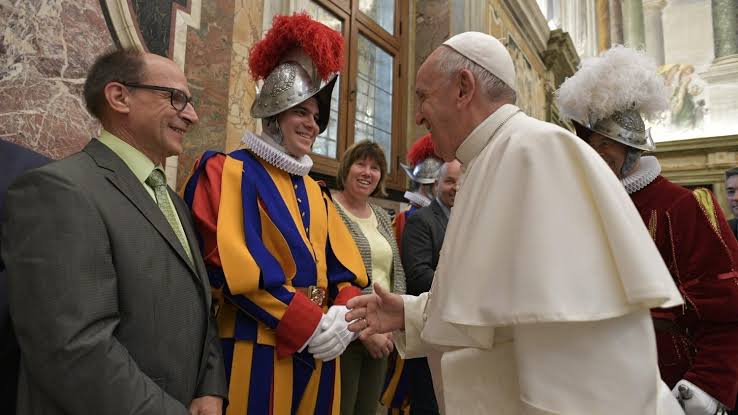
Overture: The Pontifical Swiss Guard or the world’s smallest army as often called is one of the most attractive sights one could find while visiting the ancient city of Vatican for the first time. While some posed for a photograph in the front of these men who are on guard at the gate of Vatican, others looked with awe the great and gigantic men whose statures threaten even the devil. Their responsibility goes beyond mounting sentry at the Vatican City’s gate, its environs and the Pontifical Villa of Castel Gandolfo, but also focus on personal security of the Holy Father. 

In our series this week on “The ARCHIVE” we mount our camera facing the ancient city of Rome, the Vatican City or the Papal State. Where we will take a cursory look into her security service - the Pontifical Swiss Guard. They serve the Holy Father exclusively as personal protectors, and all of Swiss origin. One may be prompted to ask, why all Swiss? The answer is not far-fetched as we journey together around the walls of this city which serves as the headquarters of the worldwide Catholic Church.

The Historical Lane: The uniqueness of the Swiss Mercenaries cannot be over emphasized right from antiquity. That is why Tacitus one of the leading great historians once said, "The Helvetians are a people of warriors, famous for the valour of their soldiers." So are the Swiss guard in all ramifications, to the extent of making a remarkable impact in the history of European politics. Due to their outstanding roles played during this epoch in history, that the evening of January 22, 1506 saw them within the Vatican City on invitation by Pope Julius II, with Captain Kasparvon Silenen, of Canton Uri leading the troop through the Porta del Popolo and entered for the first time the Vatican. They were blessed by Pope Julius II, with the prelate Johann Burchard of Strasbourg, Master of Pontifical Ceremonies at that time, and author of a famous chronicle, noted the event in his diary. 

According to record, it was Pope Sixtus IV who made a previous alliance in 1497 with the Confederates, which for saw the possibility of recruiting mercenaries, and he had barracks built for them near where there is, still today, the small Church of St. Pellegrino, in Via Pellegrino in Vatican City. Later, renewing the old pact, Innocent VIII (1484-1492) also desired to make use of them against the Duke of Milan. And Alexander VI also engaged Confederate soldiers during the time of the alliance between the Borgia family and the King of France. While the Borgias were so powerful the so called Italian Wars began in which the Swiss soldiers were always present, in the front line, at times for France, and at others to support the Holy See or the Holy Roman Empire ruled by a German sovereign. When the Swiss mercenaries heard that Charles VIII, King of France, was planning a great expedition against Naples, they flocked to enlist. Towards the end of the year 1494, thousands of them were in Rome, passing through with the French army, which in February of the following year, occupied Naples. Among the participants in that expedition against Naples, there was also Cardinal Giuliano della Rovere, future Pope Julius II, who under Pope Alexander VI had left Italy and gone to France. He was well acquainted with the Swiss, because some twenty years earlier he had been granted as one of many benefices, the Bishopric of Lausanne. A few months later however, Charles VIII was forced to abandon Naples in all haste and he barely succeeded in forcing a blockade and escaping to France. In fact, Pope Alexander VI had connected Milan, Venice, the Germanic Empire and Ferdinand the Catholic to form a barrier against the French. With the full knowledge of this Guards, that the Holy Father Pope Julius II invited them into the Vatican City, and they arrived that fateful day January 22, 1506. Since then, the Pontifical Swiss Guard as we come to know now has serve the various Popes across centuries.

The Pontifical Swiss Guard: Is also referred to as Papal Swiss Guard, or just Swiss Guard; Pontificia Cohors Helvetica or Cohors Pedestris Helvetiorum a Sacra Custodia Pontificis in Latin; In Italian they are known as Guardia Svizzera Pontificia; while in German it is Päpstliche Schweizergarde; and Garde suisse pontificale in French. They serve de facto military of Vatican City.  These men undergone military training in the Swiss army, and has their barracks close to the papal apartment. The guards, who are independent of the Swiss armed forces, are employed by the Holy Father – the Pope, to whom they swear loyalty in a ceremony at Belvedere Court. As is common with any elite military corps, competition is intense for inclusion in the Swiss Guards. New recruits must be unmarried Roman Catholic males with Swiss citizenship, between 19 and 30 years of age, and at least 5 feet 8 inches (1.74 metres) tall; they must have a professional diploma or high school degree and must complete basic training with the Swiss military. (Historically, new recruits also had to prove they were free of physical deformities, and commanding officers were traditionally of noble lineage.) The guards normally wear blue doublets and blue berets, but on ceremonial occasions they don the colourful Renaissance-era uniforms for which they are famous. They are among the oldest uniforms in continuous use. The tunics are striped in the colours of the Medici family: red, dark blue, and yellow. White ruffs and high plumed helmets (with ostrich feathers coloured to reflect different ranks) are also worn, as, on occasion, is armour. While in traditional dress, the guards carry pikes and swords, but they are also trained in the use of modern weaponry and counterterrorism techniques. The tailors of the Swiss Guard work inside the Vatican barracks. There the uniform for each guardsman is tailor-made individually. The total set of Renaissance style clothing weighs 8 pounds (3.6 kg), and may be the heaviest and most complicated uniform in use by any standing army today. A single uniform requires 154 pieces
and takes nearly 32 hours and 3 to fittings to complete. (cf. "The Pontifical Swiss Guard – Uniforms". The Vatican. Retrieved August 19, 2017.)

While both Michelangelo and a painting of the Pontifical Swiss Guard bearing Pope Julius II on a litter (by Raphael) are often cited as inspiration for the Pontifical Swiss Guard uniform, the actual uniforms worn by those soldiers included a flaring skirt; a common feature in male clothing during the Renaissance. A clear expression of the modern Pontifical Swiss Guard uniform can be seen in a 1577 fresco by Jacopo Coppi of the Empress Eudoxia conversing with Pope Sixtus III. It shows the precursor of today's recognizable three-colored uniform with boot covers, white gloves, a high or ruff collar, and either a black beret or a black Comb morion (silver for high occasions). Sergeants wear a black top with crimson leggings, while other officers wear an all-crimson uniform. The colours blue and yellow were in use from the 16th century, said to be chosen to represent the Della Rovere coat of arms of Julius II, with the colour red added to represent the Medici coat of arms of Leo X. (cf. "The Swiss Guard - The Uniform of the Swiss Guards". vatican.va. Retrieved August 19, 2017.)
At the moment the Swiss Guards’ residential quarters is located at the eastern edge of the city, north of St. Peter's Square and beside the Vatican palace. Their chapel is that of Saints Martino and Sebastiano, and the Campo Santo Teutonico, near St. Peter's Basilica, is designated their cemetery. Swiss mercenaries were long renowned as the best soldiers in the world. Further reorganizations of this Guards were made in 1959 and 1976, and in 1979 their number was fixed at 100 (a commandant, 3 other high officers, a chaplain, 23 lesser officers, 2 drummers, and 70 pikemen). In 1981 Swiss Guards helped protect John Paul II during an assassination attempt in St. Peter's Square. In fact, the plainclothes guardsman who rushed to the pope's aid became a hero and was named commandant of the Swiss Guards in 1998. Within hours of his promotion, however, he and his wife were shot and killed by a disgruntled lower-ranking guard, who then committed suicide; these were the first murders known to have taken place in Vatican City since the mid-19th century. (cf. "Swiss Guards." Encyclopædia Britannica. Encyclopædia Britannica Ultimate Reference Suite.  Chicago: Encyclopædia Britannica, 2014.)

Conclusion: Huldrych Zwingli, a Swiss Catholic who later became a Protestant reformer once said, "The Swiss see the sad situation of the Church of God, Mother of Christianity, and realize how grave and dangerous it is that any tyrant, avid for wealth, can assault with impunity, the common Mother of Christianity." This observation summarizes the pains and gory states the Holy Mother Church went through. And this formed the foundation of their invitation to the Vatican City. With their service and commitment, the Holy Father, Pope Julius II granted them the title “Defenders of the Church’s freedom.” They hold their swearing-in ceremony May 6 each year to mark the day in 1527 when 147 members of their corps gave their lives in a desperate rear-guard action that allowed Pope Clement VII to reach the safety Castel Sant’Angelo while the soldiers of Holy Roman Emperor Charles V sacked the eternal city – Rome. The pontifical Swiss Guards being foot guards with a close protection of the Holy Father as their primary role has a capacity of 100 men. Ss. Ignatius of Antioch, Martin of Tours, Sebastian and Nicholas of Flue are their patron saints. Acriter et Fidelter (Fiercely and Faithfully) remains their motto. So far they have recorded a total of three major war engagements: War of Urbino in 1517, Sack of Rome in 1527 and Battle of Lepanto in 1571. The Pontifical Swiss Guard at present has Pope Francis I as the Ceremonial Chief, Christopher Graf – the Commander and Philippe Morard as the Vice Commander.

EDITORIAL


GRATITUDE
Dearest in the Lord, greetings! On behalf of the Board of the Editors of The ARCHIVE - your one-stop E-Catholic platform, the publisher of your favourite daily reflection: DIVINE WHISPER wishes to thank you all for your patronage and support. 

Interestingly, by God's grace and mercy we will clock THREE this year September 23, (the feast day of our principal patron - St. Pius of Pietrelcina (Padrepio). Within this few years we are grateful to God for His benevolence despite our shortcomings and weaknesses.

Meanwhile, the platform will move to the next level of it's mission on INSIGHT INTO PEOPLE, PLACES AND EVENT IN CHRUCH'S HISTORY.
Kindly, stay Click on us and get refreshed.

Finally, we pray for you and with you for Divine favour, connection and protection through the intercession of Our Mother, the Undoer of Knots and St. Pius of Pietrelcina (Padrepio) our principal patroness and patron, that your heart desires may be granted through Christ our Lord.

I remain your servant in Christ,

Fr. PiusRalph EFFIONG, SMMM
(General Editor)